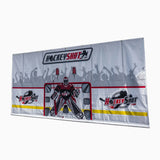
The one-timer beats goalies on time. There is no catch, no settle and no wind-up for the goalie to read, so the puck is gone before the netminder finishes sliding across. It used to take open ice and a few friends to practise. Today a passer and a shooting pad let you build it alone in a driveway or basement, though it is always more fun with friends.
A one-timer is a shot taken in one motion straight off a pass, without stopping the puck first. Your timing, body position and blade angle all have to line up in the instant the puck arrives. This guide covers what to work on, the gear you need and a drill progression from stationary reps to shots on the move.
How to build it
- Master the slapshot firstThe one-timer is a slapshot off a moving puck.
- Groove the swing, then add the passStationary reps before live feeds.
- Add footwork lastGame one-timers happen on the move.
Before You Start
Make sure your slapshot and snapshot are already solid. The one-timer uses the same body position as a hard slapshot. If you are not yet confident with your slapshot, build that first with these shooting drills and come back to the one-timer.
What Makes a Good One-Timer
A clean one-timer comes down to four things, and none of them is raw strength.
- Timing
- Start your downswing a little before the puck arrives. Too late and it slides between your legs. Too early and you swing at nothing. Take a quick wind-up for a hard pass, a bigger one for a slow pass.
- Body position
- Open your chest and hips to the passer and have the puck come from in front of you. A pass from behind or from your backhand side is very hard to hit cleanly.
- Weight transfer
- Load your back leg with the stick already back, then drive from the back foot to the front foot as you swing through the puck.
- Blade angle
- Keep the blade slightly closed to hold the shot down, and follow through low toward your target.
Gear for One-Timers at Home
You need something to feed the puck back, a smooth surface to receive it on and something to shoot at.
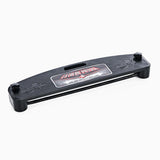
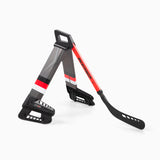
Extreme Passer
Pass into it and it sends the puck right back, so you can rep one-timers without a partner. Clamps onto a shooting pad, dryland tiles or synthetic ice.
Roll-Up Shooting Pad
A large, smooth surface for receiving passes and shooting. It rolls up for storage or travel. The Pro Shooting Pad is a smaller option.
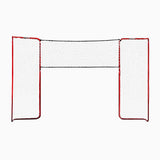
Hockey Net
Gives you something to aim at and keeps pucks from scattering. Add shooting targets in the corners for accuracy.
Use standard 6 oz pucks so the feel matches game pucks. Set the net 5 to 10 feet away to start, so you can focus on clean contact before power. For a full layout, see our guide to setting up a home hockey training space.
Drill 1: Stationary Reps
Start planted, with no pass, and groove the swing.
- Set a wide, balanced stance, body open to where the pass will come from.
- Place a puck at your contact point, roughly off the toe of your front foot.
- Load your back leg and take the stick back to shoulder height.
- Swing through the puck, drive to the front foot and follow through low at the net.
- Repeat 15 to 20 times, hitting the same spot each rep.
Once the swing feels repeatable, slide a puck across your body by hand or stick and time your swing to meet it at the same spot.
Drill 2: Adding the Pass
Position the passer off to your side so it returns the puck across your body to your contact point. Start with slow, soft feeds.
- Feed the passer and get your stick back before the puck returns.
- Track the puck all the way in, eyes down until contact.
- Meet the puck at the front of your stance, not behind you.
- Transfer your weight and follow through at the target.
- Speed up the feed only once contact stays clean.
Twenty crisp one-timers teach you more than a hundred rushed swings. If you miss or catch the puck late, slow the feed until your timing resets.
Drill 3: Moving One-Timers
Game one-timers rarely come from a standstill. Feed the passer, take a step or two to a new spot, then catch the return in stride and shoot without stopping. Keep your hips open as you move so you do not twist at the last second. Start with one step, then add a glide or a curl into the shot.
Work both sides. Most players default to their forehand, but a one-timer from the off wing makes you much harder to defend. To sharpen the passes that set it up, add these solo passing drills to your sessions.
What to Do With a Bad Pass
If the pass is a little off, move so it arrives in your sweet spot. Step forward if it is too far in front. If the pass is really bad, stop it and then shoot. A controlled puck beats a weak one-timer.
Your One-Timer Practice List
Common One-Timer Mistakes
| Mistake | Fix |
|---|---|
| Swinging too early or too late | Slow the feed and get your stick back sooner, so you wait on the puck |
| Eyes leave the puck | Watch it all the way to the blade, especially on the move |
| Stiff back leg | Bend the knees, load the back leg and drive through |
| Swinging for max power | Meet the puck cleanly first, power comes with timing |
Start Training
Groove the motion with a passer and a net, add speed and footwork as you go, and the one-timer becomes a shot you can trust in a game.
Ready to train? Shop Passers Shooting Pads